Strikes
A strike is the heaviest form of industrial action. During a strike employees do not go to work. We have gathered on this page the information on your trade union JHL’s strikes and strike benefit.
Trade Union JHL defends its members’ terms and conditions of employment. Sometimes this requires resorting to industrial action. The trade union offers the best safe haven in the storms of working life. Join JHL before the strike starts so that you can get a strike benefit when you participate in the strike.
Agreement for the private social services sector – the strikes are cancelled
The private social services sector has a new collective agreement. Trade Union JHL and the employer association HALI have reached a negotiation result whereby JHL joins the agreement that was concluded earlier.
We will pay a strike benefit to make participation in the strike possible. The benefit will be paid for each day when you have been on strike. For example in the strike of the private social services sector in early 2026, the strike benefit was €140 per day.
In order to be eligible for the strike benefit, a member needs to have paid the membership fees and must abide by the decisions and instructions issued by JHL.
We will send more detailed instructions once the strike benefit can be applied on myJHL.
Read the most frequently asked questions about strikes and industrial action.
Strike-related instructions to members
Preparing for a strike, being on strike and returning to work after the strike
The industrial action notice, or strike warning, always describes what work the strike applies to. A strike decision by JHL is binding on its members.
A strike warning always indicates the time of day when the strike begins and when work must end. After that time, no one should go to work.
Other JHL members, members of other unions and non-unionised employees are not allowed to do work subject to the strike action.
Work covered by a strike cannot be outsourced to temporary agency workers or other temporary workforce. In accordance with international practices, job agencies must not supply employees to companies subject to a legal industrial action.
Once a strike warning has been issued, you cannot schedule an annual holiday for the strike period.
How to prepare for a strike:
- Work normally in accordance with the shift roster until the strike begins.
- Do not do work in advance.
- You must also not leave any work undone before the strike.
- When you leave the workplace, take with you any personal belongings that you need during the strike. At the employer’s request, you must hand over any fringe benefits (such as a phone or computer).
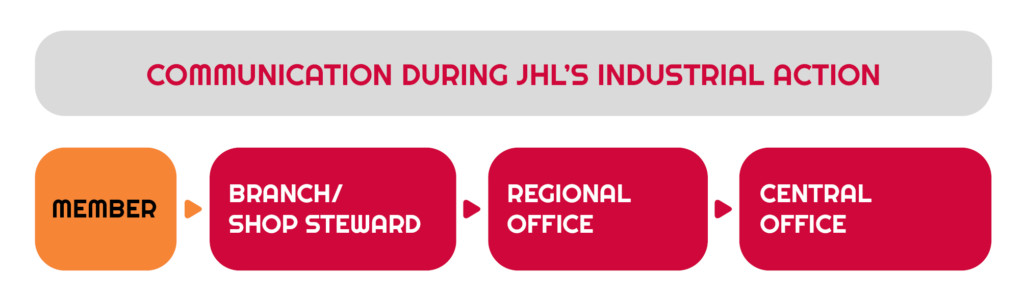
- Check that you have the contact information of your shop steward and/or strike committee.
- Follow the union’s communications: JHL’s website, social media channels, member letters and other communications. Your shop steward will give you more information.
- Check your membership information in myJHL (e-mail address, phone number, employer, workplace, occupation). In the event of a strike, we will send messages to members’ personal e-mail addresses and phone numbers.
- Check your membership information in myJHL.
- Also recommend your non-unionised co-workers to join the union.
- Follow the union’s instructions
- Participate in monitoring the strike by, say, being a picketer or a picketer supporter
- Prepare in advance and notify the shop steward and/or strike committee if the employer tries to exert pressure.
- Attend strike meetings
- JHL members who are not on strike will continue to do their own work, they do not do the work of those on strike.
- Follow the union’s communications
- Remember that the only reliable source of information during the industrial action is the union.
Do not do work that is covered by the strike!
Remember that the employer must not exert any pressure on you in any way if you are taking part in a union-organised industrial action! JHL is prepared for countermeasures. For more information, contact your shop steward or the regional office.
Return to work after the strike according to the shift roster or the agreement on ending the strike.
The agreement on ending the strike sets forth the measures and conditions to end the strike.
Strike benefit
Apply for a strike benefit after the end of the strike through myJHL. The strike benefit needs to be applied within 2 months from the end of the strike. After that, the application system will be closed.
Join JHL, get a strike benefit
You can get a strike benefit when you join JHL before the start of the strike. Use the online membership application form so that we can see precisely when you have joined.
The strike benefit will be paid when you have paid your first membership fee.
Trade Union JHL decides the amount of the strike benefit separately for each strike. We inform the members about the amount of the strike benefit each time with messages. Remember to check that your contact information is up to date in myJHL.
NOTE! For a week-long strike, the strike benefit is paid for a maximum of five days. This decision applies to all of JHL’s week-long strikes.
A strike benefit is paid to members whose work was subject to a strike and who have been on strike.
The member must meet the following conditions to get the strike benefit:
- The member has joined the union before the strike started, and at least the first membership fee must be paid before the strike benefit can be paid.
- Also “old” members must have paid their membership fees.
- The member must abide by the decisions and instructions issued by JHL.
If you have joined the union right before the strike, it may take a while before the strike benefit application form appears in myJHL because we have a lot of membership applications to process.
JHL’s strike benefit is paid to your bank account as soon as possible. We process strike benefit applications on a rolling basis.
Please remember that the benefit is not paid to strikers automatically. You need to apply for it! Submit your application in myJHL within two months from the end of the strike.
A strike benefit cannot be paid in the following situations:
- If you work during a strike with a permission to work or do emergency work, strike benefit is not paid for that working day or work shift.
- If you join JHL when the strike has already started, you cannot get the benefit.
Applying for a strike benefit on false grounds is a fraud.
The part of a strike benefit that exceeds EUR 16 is income subject to tax (88 §, Income Tax Act, tuloverolaki, TVL, decision by the Finnish Tax Administration ). You do not need to submit your tax card. After the strike is over, JHL will pay benefits once a week. The union report the paid strike benefit amount to the Finnish Tax Administration.
Applying for a strike benefit in myJHL membership service
- Sign in to myJHL.
- Select “Strike benefit application” near the bottom of the column on the left.
- Enter your bank account details on the application form, mark your strike days, and assure that the information you have provided is correct.
- Save.
- Next, your member branch will review and approve the application, and after approval it moves to payments. Benefits are paid once a week.
If you have not signed in to myJHL before, read the instructions on the myJHL info page.
Strike benefit for members of other SAK-affiliated trade unions
When members of other SAK-affiliated trade unions participate in a strike that has been declared by JHL, they apply for the strike benefit using a web link. You will get the benefit application web link from JHL’s regional office for the strike area.
We will verify your membership in the other SAK-affiliated trade union. The verification process may slightly delay the processing of your benefit application.
Frequently asked questions about strike action
Strike basics
The union tells people the times when the strike starts and ends. Follow the union’s communications and make sure that your membership information is up to date. You can check your membership information on myJHL.
No salary is paid for the strike period. However, pay and other receivables arising from the employment relationship that have fallen due will be paid during the strike on the normal salary payment dates. Employees are also not entitled to fringe benefits offered by the employer, such as lunch vouchers, for the strike days.
The strike benefit is paid only to union members who have paid their membership fees. If the strike lasts, say, one week (for example from Monday to Sunday or from Tuesday to Monday), the strike benefit will be paid for five days.
A condition for the payment is that you abide by the decisions and instructions issued by the union. The Executive Committee shall decide on the amount of the strike benefit. You can apply for it within 2 months from the end of the strike.
For more information about strike benefit payment, visit the Strikes and other industrial actions page.
Will I be paid a strike benefit if I join JHL?
You will be paid a strike benefit if you joined the union before the strike started. Use the electronic membership form so that we can see your exact joining date. At least the first membership fee must be paid before the strike benefit can be paid. When your membership has been confirmed, you will get instructions on paying the membership fee.
A political strike is a strike declared by the trade union. Its primary goal is not to affect collective agreements or employers, but rather the purpose is to pursue political or societal goals.
Participation in a political strike is an acceptable reason for absence, and the employer cannot impose measures on the employees for their participation.
A lockout is an industrial action by the employer. In a lockout, the employer denies employees access to the workplace and interrupts the payment of salaries.
If an employee continues a strike when the Labour Court has ruled that it is illegal industrial action, the employee may be ordered to pay a penalty fee of EUR 200. Imposing the penalty fee requires both a judgment by the Labour Court and continuing the strike despite the judgment. The employee must furthermore have the information that the strike has been judged as illegal. So far (April 2025), there is no precedent on this matter
Legal strikes are connected for example to negotiating a new collective agreement (during a period without agreement). The law gives trade unions and employees the right to strike in these situations.
Once a strike warning has been issued, annual holidays cannot be scheduled for the strike period. A holiday cannot be scheduled to start during a strike that has already begun. If your annual holiday began before the strike, it will continue in spite of the strike, i.e. you will be on an annual holiday and not on strike. The employer has to pay the salary as usual for the duration of the holiday.
If the strike continues after your holiday ends, you will have to notify the employer that you are returning from the holiday and going on strike – otherwise your absence may be interpreted as a so-called unauthorised absence. It is best to submit the notice in writing.
Annual holidays taken during the strike are equated with workdays when future annual holidays are calculated, i.e. annual holidays are accrued during this time.
If the strike begins before a confirmed annual holiday begins, the annual holiday will be automatically cancelled. The employer is obligated to grant the cancelled annual holiday at a later time. If the annual holiday continues after the strike ends, the employee will stay on the annual holiday.
Whether an employee is on strike or holiday does not depend on when the holiday was confirmed. The industrial action notice does not determine this either. What is decisive is which one actually begins first: the strike or the holiday. This is called a chronological priority principle.
The annual holiday of a public servant may be postponed or, if the holiday has already begun, interrupted, in case postponing or interrupting it is necessary for cogent reasons related to the use of public authority, or if it is necessary in order to carry out work tasks related to health or safety. A strike does not meet the definition of a cogent reason for postponing one’s annual holiday. However, a need for protection work arising from the strike may meet this definition.
If you have booked an occupational health appointment before a short strike begins, it is unlikely that your employer would not allow the appointment. As for illnesses that begin during a strike, the employer may withdraw your right to use occupational health services.
If your sick leave has started before the start of the strike, your right to a sick pay is determined by the collective agreement. Submit your medical certificate concerning the sick leave to the employer before the strike begins.
If the strike has begun before you fell ill, you are not entitled to sick pay. Apply for daily sickness allowance from Kela.
If your sick leave continues after the strike has ended, your right to sick pay is determined by the collective agreement.
An employee who falls ill when on strike should immediately obtain a medical certificate.
“Pekkaspäivät” days are time off that is granted to shorten the working time of those who work a 40-hour week. If such time off has been assigned to the time when the employee is on strike, it is not spend during the strike. The employee has the right to get new time off after the strike, either as days off work or, if that is locally agreed, as compensation for lost earnings.
Exceeding the period of taking the time off does not affect this.
No, it does not, if you are not in an employment relationship with the organisation offering the traineeship.
Bear in mind that your traineeship may not be used to break the strike.
You cannot fill in if there are shortages in personnel resources or work performance caused by industrial action. A student’s responsibility differs from an employee’s responsibility. For example, you cannot be left to work alone in a shift.
Contact your shop steward or the regional office to make sure. The union informs separately whether stand-by work falls within the industrial action.
Contact the regional office. You have no obligation or right to perform work covered by a strike.
Yes, you can, if the work that is offered is not within the scope of the industrial action. Remember, however, that if the union has issued a ban on overtime and/or shift swaps or a ban on temporary transfers, the ban applies also to temporary employees.
If the strike interrupts the work trial briefly, it will not affect the benefits paid by Keva. If the work trial is interrupted for a month or a longer period, the payment of benefits will be discontinued.
For more information, visit Keva’s website.
If a strike is based on a union decision, it is binding on the members. The Criminal Code of Finland prohibits work discrimination, which means that employees must not be placed in an unequal position due to their participation in a strike.
Contact your shop steward if your employer threatens you. Each threat will be taken seriously and investigated. Ask for help.
JHL’s Executive Committee may also decide on an embargo or a boycott against a company that recruits temporary/external workforce for the duration of a strike, pressures employees to come to work during the strike, changes shifts that have been announced earlier due to a strike or threatens to place employees in an unequal position depending on whether they participate in the strike or not.
No, they cannot. When industrial action is carried out by a trade union, the employer does not have a right to terminate or cancel the employment contract because the employee participates in the industrial action
An employee’s participation in industrial action (strike) based on a union decision does not entitle the employer to cancel or terminate the employment contract or to end the employment of an employee who is on a probation period or of a fixed-term employee. It is also prohibited for the employer to discriminate against employees who participate in a strike when it comes to decisions on, for example, working hours, pay increases etc. (Criminal Code of Finland, chapter 47).
Of course not. Industrial action is always a matter between the union and the employer. The union is responsible for the situation that arises on behalf of its members in relation to the employer. If it is not possible to discuss the strike in an appropriate manner in your workplace, it is enough for you to say that the strike is the union’s decision. As a member, you have the obligation to abide by the decisions that have been made without it resulting in any consequences for you.
All inappropriate behaviour is to be condemned. Contact your shop steward or regional office if you experience threats.
If your employer tries to prevent you from using your right to participate in a strike, contact your regional office.
During a strike the employer can make employees do work that belongs to them according to their employment contract but not work that is subject to strike action.
Yes, you can.
Go to your workplace normally in accordance with the shift roster and be available to your employer.
Do not perform work that falls within the scope of the strike!
Protection work (also called “essential work”) means work that has to be done during industrial action in order to prevent danger, as a direct consequence of the industrial action, for example to people’s lives or health, the environment, or machinery and equipment that are essential for the operations of the workplace.
The employer and the employee association must negotiate on how such injuries and damage are avoided. This kind of negotiating does not belong to individual members.
The employer must notify the employee association without delay of the hazards of the industrial action so that negotiations on protection work can be started.
Your trade union will provide more detailed instructions if needed.
Emergency work is work that is done due to an unforeseen event to protect life, health and/or property. A strike notice is issued well in advance, and this means that a strike is not an unforeseen event, and therefore it is not a reason to require emergency work. Follow other instructions from your trade union.
After an industrial action notice has been issued, shop stewards will negotiate about this at local level if needed.
Public servants can legally participate in industrial action taken on the basis of a decision of the union or branch.
Public servants’ right to strike has been restricted, however. They are not allowed to take part in sympathy and demonstration strikes nor in bans on overtime and shift swaps. In addition, they do not have the right to participate in political strikes.
Public servants are under the obligation to perform protection work also during industrial actions. Protection work is work that is necessary to prevent the health or lives of citizens from being endangered or to protect assets that are specifically endangered due to the industrial action.
The National Dispute Impact Assessment Board assesses whether the announced industrial action will jeopardise society. If it does, the Board must in its decision exhort to cancel the industrial action altogether or to limit it as specified in the decision.
During industrial actions by other unions, public servants are obliged to fulfil their normal service obligation.
No they can’t, because the right to study leave is based on the Study Leave Act. Thus, your study leave can’t be cancelled, so you can go on leave despite the strike. Unless a separate agreement has been made about paid study leave, the leave is unpaid.
When you’re on study leave, you’re not entitled to strike benefit.
If your family leave has started before the strike, you will be paid your salary for the duration of the family leave in accordance with the collective agreement.
If your family leave begins during the strike, apply for Kela’s daily allowance for those family leave days that intersect with the strike. No strike benefit is paid for the days in question.
Irrespective of when the industrial action takes place, statutory maternity and parental leaves are comparable to employment, also when accruing annual holiday.
If your unemployment began before the strike, the strike will have no impact on the payment of the unemployment allowance. The strike will also have no impact on the payment of unemployment allowance in a lay-off situation if the lay-off notice has been issued before the strike warning and the lay-off begins before the strike begins.
If you have been granted a discretionary leave of absence before a strike, you cannot cancel the leave because of the strike. You will go on leave despite the strike, and no strike benefit will be paid to you. If you are on unpaid leave, you are also not entitled to a salary.
You can also participate in courses during a strike if
- you have agreed on attending a course before an industrial action notice was issued
- the course will not take place in the workplace
- the teacher of the course is not an employer representative
- you will not have to do overtime work because of the course
- the course has to do with a position of responsibility or occupational competence needed for managing one’s job.
A picketer is a person monitoring that the strike is implemented.
Picketers’ task is to encourage all those wishing to perform work that is within the scope of the strike to leave the workplace. Picketers maintain order in front of the workplace on strike, distribute strike bulletins, and monitor employers’ actions.
Dependable and calm persons who do not lose their patience even in tough situations are selected as picketers. Picketers represent the union and are therefore also strikers. They do not have the right to enter the workplace or work areas or to use the employer’s equipment.
If you want to be a picketer, contact your shop steward or regional office.
The nature and area of responsibility of the strike committees always depend on the nature of the strike. Strike committees may be regional, local or company-specific. Strike committees are in charge of the strike in their respective areas of responsibility and take care of strike-related tasks.
A regional strike committee, for example, liaises with the shop stewards and contact persons in the locations on strike, among other things.
JHL’s general industrial action guidelines help branches and joint organisations to maintain readiness for industrial action and to carry it out. The guidelines define a strike, explain the strike organisation and provide information about the consequences and effects of a strike. JHL’s industrial action guidelines
The only reliable sources of information are the trade union and the strike organisation. First, contact your shop steward. If they are unable to help you, contact your regional office. Follow the union’s communications through the website and social media channels.
Participating in a strike
Yes. Work that is subject to strike action is not done. This concerns also people who are not members of JHL, including members of other trade unions and non-unionised employees. Even remote work is not allowed during a strike.
No, you are not obligated to tell your supervisor whether you are a union member or not. Union membership is particularly sensitive personal information. That is why membership information is protected with special care by the General Data Protection Regulation. If you observe a data protection violation in your workplace, report it immediately to the regional office.
If you do not participate in a strike organised by your trade union, your branch may terminate your trade union membership.
All employees will not necessarily be on strike, but they will also not be carrying out strikers’ work tasks. The union’s industrial action notice will contain information on whom the strike concerns.
It is important that those JHL members who are not on strike will only perform their own work tasks and not the tasks of those on strike.
Those who are working shall refuse to perform any of the tasks of those on strike, for example by agreeing to change their tasks or work shifts.
Do not perform work that falls within the scope of the strike!
As a general rule, all JHL members in the selected workplace will participate in the strike. The decision is a union decision (= made by the union’s administration) and it is binding on the members. Employees do not need to separately inform their supervisors that they will participate in the strike. Employees have a legal right to participate in the strike.
It is not permitted for the employer to exert pressure on employees who participate in industrial action organised by the union. All employer countermeasures must be warded off and false rumours refuted, and members must immediately inform a shop steward or branch official about all countermeasures. They will in turn notify the union’s regional office. For more information, contact the shop steward or regional office.
JHL determines the strike limits. The union decides that certain work duties are subject to strike action, and that does not depend on who does the work. As a rule, shop stewards and occupational safety and health (OSH) representatives who are within the scope of the strike limits participate in the strike if the strike applies to their work duties.
An OSH representative is selected by the employees through election. The OSH representative represents all personnel of the workplace, including also those employees who are not union members. It is possible that during a strike, some of the employees who the OSH representative represents are on strike and some are not.
A shop steward is also chosen at the workplace through election. A shop steward is always a union member. A shop steward represents primarily organised employees, i.e. those who are members of the trade union. It is possible that some of the employees who a shop steward represents are on strike, and some are not. This depends on the strike limits and work duties.
Most shop stewards and occupational safety and health representatives take care of the duties of their role alongside their job duties, and only part of their working hours is released for taking care of their shop steward or OSH representative responsibilities. During the rest of their working hours, they carry out the tasks specified in their employment contract.
If the shop steward’s or the OSH representative’s own work is within the scope of the strike, they, too, are on strike. In such case, their deputy person will then take care of the necessary tasks of shop steward/OSH representative during the strike. If all deputies are members of the trade union that is on strike, and the strike applies to their work duties, they will all be on strike.
A shop steward or OSH representative may also be needed for example because of the employer’s countermeasures.
A full-time shop steward and OSH representative will be working in their position of responsibility and be available for the people they represent also during industrial action.
Students who are on an unpaid on-the-job learning or work placement period are excluded from the strike during the practical training/on-the-job learning period. The reason for this is that they are not in an employment relationship.
Apprenticeship students, on the other hand, are included in the scope of the strike if they are learning at the workplace. The reason for this is that they are in a fixed-term employment relationship.
It is also important to note that students who are training at a workplace cannot have the same responsibilities as someone who is in an employment relationship. They cannot be counted as part of the staffing level. Also, training time cannot be changed into a paid work shift because then it would be work and not training.
Students’ on-the-job learning and training are excluded from strikes so that their graduation would not be delayed because of industrial action. Students need to make sure that they have an instructor resource for their training also during industrial action. Students should remember that their teacher/education provider must guide/instruct them on this matter as well.
Strike of another union and non-unionised employees
You should absolutely join the union. Only union members are entitled to the union’s services also during a strike, and the strike benefit is only paid to members.
It is advisable to belong to the union that negotiates the collective agreement for your sector. If you work in a JHL agreement sector which is on strike and you are a member of an SAK-affiliated union, you will receive the strike benefit. Check if your union is an SAK-affiliated union.
When the industrial action has been decided by JHL, the members of other SAK-affiliated unions apply for their strike benefit from JHL.
If you don’t normally do the work in question, you should also not do it during a strike. Notify your supervisor that you don’t do work subject to a strike action. If your supervisor exerts pressure on you, contact your shop steward or regional office.
Don’t do work subject to a strike action!
Also see the guidelines of your trade union JHL: Guidelines in case of another union’s industrial action