Collective agreement for the private social services sector
There are thousands of workplaces in Finland that produce private social services. JHL represents all occupational groups in this agreement sector, with practical nurses being the largest of our groups. We want to take care of the functionality and interests of the entire service chain.
More information will be added on this page. Please check back later for updates.
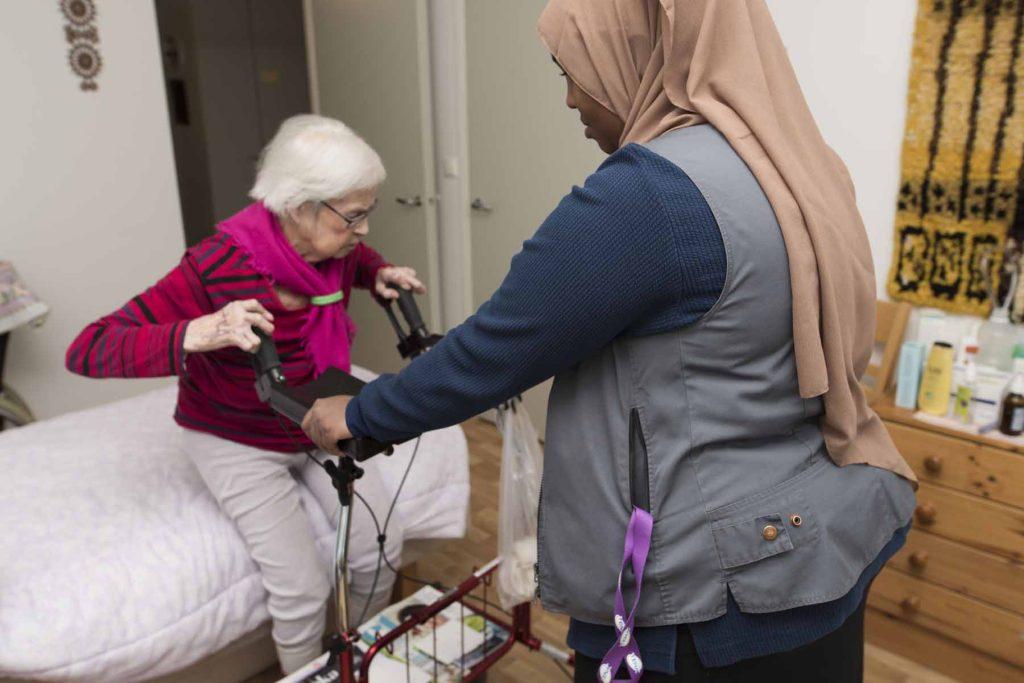
Employees of this sector work for example in assisted living and nursing homes for the elderly, housing services for people with disabilities, mother-and-child homes, shelters, substance abuse services, child protection, and as personal assistants. Occupational titles covered by the collective agreement for the private social services sector include for example practical nurse, care assistant, qualified nurse, social advisor, social service professional and personal assistant.
The collective agreement for the private social services sector is generally applicable, which means that even if an employer is not a member of the employer association, the provisions of the collective agreement still apply to that employer and its employees.
If you work in the private social services sector, JHL negotiates your terms and conditions of employment. JHL is the best trade union for you in any of this sector’s numerous occupations. We will support you in the world of work.
Join JHL!
If you work in the private social services sector, Trade Union JHL is on the side of employees just like you. Our members work for example as practical nurses, care assistants, social pedagogues, and personal assistants.

Collective agreement for the private social services sector
JHL uses unofficial short names y-sostes ja ysostes for the collective agreement for the private social services sector. Note that other organisations may also use other names.
English translation of the collective agreement will be added on this page in autumn 2026.
More information about the collective agreement for the private social services sector
Pays in the private social services sector
Pays is the private social services sector are grouped into six pay groups (A, B, C, D, E, and F). Each group includes several pay grades that start with the letter G. The collective agreement determines the minimum pay grade of each pay group. The Helsinki metropolitan area (Helsinki, Espoo, Vantaa, Kauniainen) and the rest of Finland have separate pay schedules. An employee’s basic pay gets increased by service increments.
The following factors affect your pay group:
- education and trainings
- experience
- how demanding the work is
How demanding the work is affects your pay grade within the pay group.
Your basic pay will increase in accordance with the pay scale after 5, 8 and 11 years of service that entitles you to a service increment.
Check right at the start of your employment if you are entitled to a service increment in your new job.
When you make your employment contract, review with your employer which of your earlier work qualifies as service that carries an entitlement to a service increment. Present testimonials for the work that carries an entitlement to a service increment.
Service that carries an entitlement to a service increment is such work in the service of one’s own employer, and other similar work, in which the working hours have been, on average, at least 19 hours a week. When entitlement to the increment is calculated, employment relationships are taken into account if they have lasted for a minimum of 14 workdays and the employee has earned annual holiday for those calendar months (based on either the 35-hour or 14-day rule).
Similar work means work that essentially benefits the new job. It includes at least work experience in the same professional field, in the same or higher pay group or in a pay group that is one level lower.
The professional field can be for example
- nursing, care and guidance work in the social welfare and health services sector
- kitchen work
- building maintenance work
- office work.
If you have after 1 February 2000 done part-time work (on average less than 19 hours per week) or worked in employment relationships that have been shorter than 14 workdays, these, too, have to be taken into account when your entitlement to a service increment is calculated. Your employer has to assess how many full months of service increment accumulation your part-time or temporary work is equivalent to.
Part-time and temporary work performed prior to 1 February 2000 can be taken into account following the same principle.
If you have work experience of other than similar work, your employer can count it as experience entitling to a service increment if the employer deems that it increases your competence for the job.
If you study social services, an employer can make an agreement with you on a paid trainee period that is part of your studies. Your pay during that period is at least 90% of the standard pay grade for the work in question.
If you do apprenticeship training, your employer can agree with you on a pay that is 90% of the standard pay grade for the work in question.
If you start apprenticeship training with your current employer, your pay cannot be lowered from what you earn now.
Guidelines
Guidelines on framework agreements, fixed-term employment and part-time employment
Clear terms of the employment relationship are the foundation for well-functioning work. That is why the employer and employee organisations in the private social services sector have created together guidelines that help to understand important agreement types in the world of work and their terms and conditions and to consider the rights and obligations that the collective agreement and the law provide for each agreement type. The guidelines cover for example framework agreements, fixed-term employment contracts and part-time work.
The goal of this collaborative effort has been to provide practical and clear guidelines for those situations where terms of employment relationships are agreed.
Join JHL!
JHL is the most diverse trade union in Finland. Our members work in about one thousand different occupations in welfare and public services. You can be for example a social welfare or health care professional, a youth worker or an early childhood education and care professional, a cleaner, a cook, a secretary, a security guard or a train conductor, and we are your trade union!